


The world of e-commerce and digital strategies evolves rapidly. This blog may contain insights that have since been surpassed by new developments. Curious about the latest trends and fresh perspectives? Dive into our most current articles on Insights.
For months now, impressions in Google Search Console have been declining for almost all businesses. The logical question clients and the industry are asking is: How do we appear more in AI, or how do I get those impressions back? This drop in impressions isn't even due to a loss in ranking, but rather a shift in search behavior and the fact that people are starting to click less in the standard Google SERP environment.
The data points in the same direction. Only 11 to 12 percent of the URLs cited by AI assistants also appear in Google's top 10 for the same query. This means almost 90 percent of AI citations go to pages that are NOT at the top of Google. That's not a marginal deviation. That's a different game. That was the moment I realized something fundamental had shifted.
In this article, I explain how an LLM works, why ranking in AI differs from ranking in Google, and I provide five practical tips to get started tomorrow.
A Large Language Model is not a knowledge base. It's a prediction engine.
Trained on billions of texts, an LLM recognizes patterns and relationships between concepts. It doesn't "understand" facts the way you and I do. It recognizes language patterns. The more consistently your brand appears in those patterns, the greater the chance it will retrieve you in relevant contexts.
In four layers. First, it analyzes your query for intent and entities. Then, it activates patterns from its training data. Next, it generates an answer, token by token. And for search-grounded systems like Google AI Mode or ChatGPT Search, a fourth step is added: live web search via RAG (Retrieval Augmented Generation).
That fourth step is interesting for SEO, because you can still anticipate it. But beware: not every answer uses web search, and the mix varies by platform.
An AI system doesn't formulate just one search query. It formulates dozens simultaneously.
If someone asks "What is the best SEO strategy for e-commerce in 2026?", the system splits that question into sub-queries: "SEO trends e-commerce 2026", "structured data webshops", "AI search optimization", "technical SEO checklist". These are executed in parallel. The AI then synthesizes an answer from all the partial results.
The implication: you shouldn't just rank for your main term, but also answer the sub-questions you don't even see.
This, in my opinion, is the core. AI systems don't think in keywords. They think in entities.
An entity is a unique "thing" with properties and relationships. A person, company, product, or concept. Sero is an Organization. We do SEO and AI automation. We are based in the Netherlands. We are related to content marketing, AI, and search. That's how an AI sees us. Not as a URL with backlinks, but as a node in a web of relationships.
In vector databases. Every concept, every word, every entity is stored as a vector (see image). Semantically related concepts are located close to each other. The more consistently your brand appears alongside relevant concepts, the stronger your position in that space.
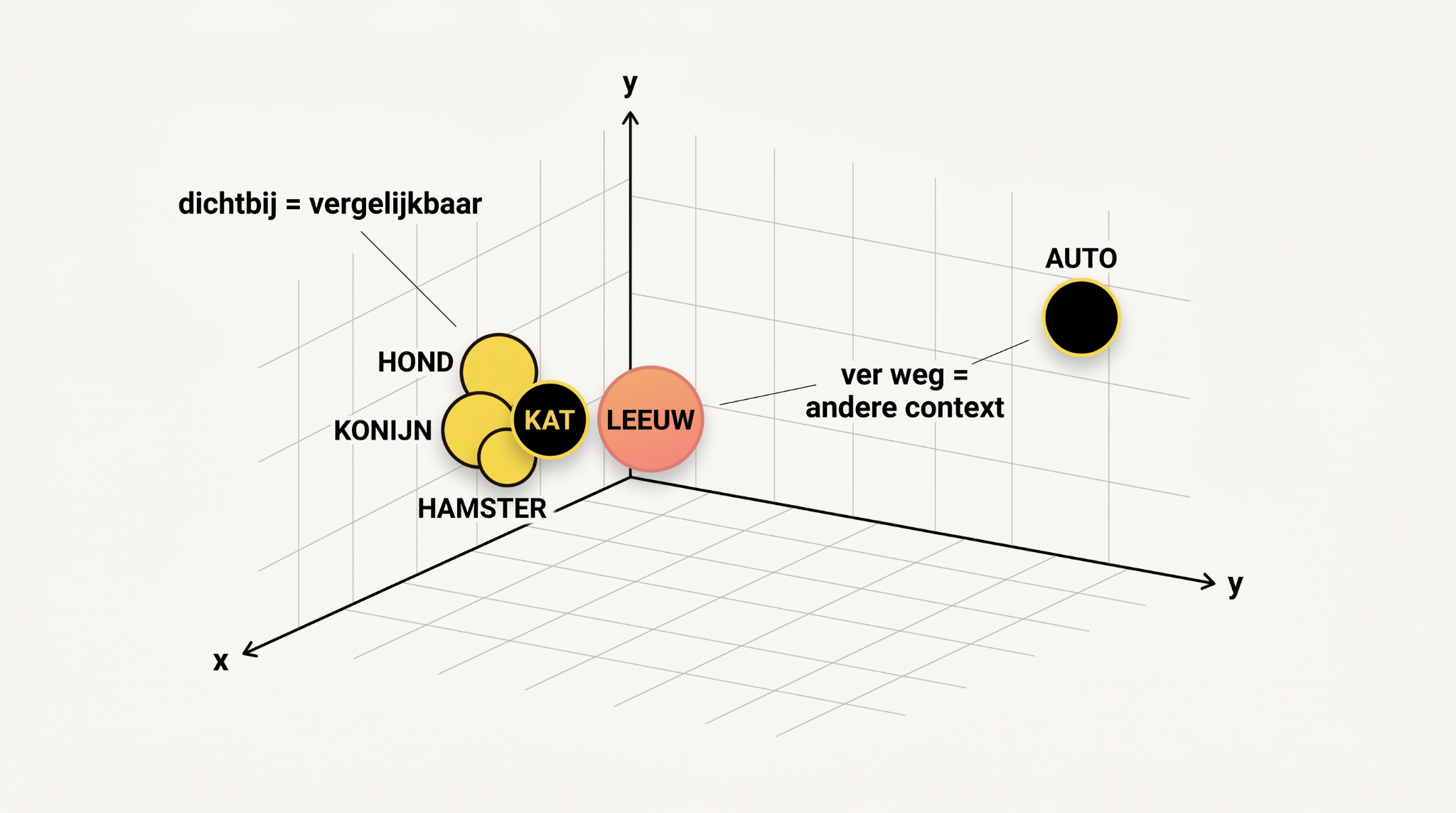
In practice, yes. Branding is how people recognize your brand: consistent name, message, appearance. Entity SEO is how machines recognize your brand: consistent data, structured markup, mentions. It's the same discipline viewed from two perspectives.
A podcast, a PR mention, a Trustpilot review: all data points that strengthen your entity in the vector space.
In three steps. First, it scans hundreds of sources for relevance in seconds (Explore). Then, it cross-references claims between sources to find consistent information (Verify). Finally, it selects the most reliable sources and cites them (Cite).
Blocked or poorly crawlable pages are eliminated in step one. Conflicting claims are eliminated in step two. Sources with structured data and clear author information have a better chance, although there's no guarantee.
For Google, authority revolves around links. For LLMs, it revolves around recognition.
Specifically: Google counts backlinks as votes, uses anchor text to determine context, and considers site-wide reputation signals. LLMs work differently. For them, it matters whether your brand is mentioned, even without a hyperlink. The context around that mention determines its meaning. And consistent information across multiple sources carries more weight than a large link profile.
No, but the balance is shifting. A large-scale Ahrefs study from 2026 among 75,000 brands found a clear statistical correlation between web mentions and AI citations. Between backlinks and AI citations, that correlation was barely present.
In statistical terms: mentions correlate moderately strongly with AI citations (correlation coefficient 0.66, a meaningful pattern), while backlinks show practically no correlation (correlation coefficient 0.10, statistical noise). What that means in practice: mentions in news media, trade journals, and reviews are more valuable for AI visibility than a traditional backlink.
Not as a gimmick, but because AI processes content in chunks. Every heading is a potential extraction point. A blog that starts with three paragraphs of introduction before the first tip no longer works. What does work: an H2 as a concrete question, an answer in two sentences below it, and only then the explanation.
Organization, Article, Product. Those three are the workhorses. FAQPage and HowTo have largely been removed from our standard package. Google has drastically reduced their rich results since 2023 (FAQ mainly for government and health sites, HowTo only on desktop). The old best practice "add FAQ schema to every page" is dead. What still works: schema that makes your entity machine-readable.
Not everything, but the balance. A guest blog in a trade journal is worth more than five links from a PBN. A podcast appearance is worth more than a directory submission. Google still uses PageRank, so links remain relevant. But the ratio between what I invest in link building versus PR is completely different from two years ago.
Not automatically, not everywhere. But for topics where timeliness is crucial, add "last updated" as a signal. Update where it matters, leave it alone where it doesn't.
AI cites YouTube in 18 percent of answers that include external sources. A blog-only strategy misses out on citations.
"What is the best strategy for e-commerce SEO in 2026" performs differently than "best strategy SEO". Optimize for the natural language people use when querying AI.
One pillar page on your main topic, plus six supporting articles covering sub-topics. AI recognizes depth. Individual posts on varied topics yield less than systematic coverage.
Descriptive anchor texts, not "click here". Internal links tell AI crawlers how your content is connected. That's free topical authority.
The playing field is changing. Those who continue to optimize solely for the Google top 10 will miss out on the vast majority of where their traffic will come from in two years.
Most SEO factors are still relevant for LLM citations, but the way you can be found, verified, and cited by LLMs introduces additional rules that require you to refine your content.


