


The world of e-commerce and digital strategies evolves rapidly. This blog may contain insights that have since been surpassed by new developments. Curious about the latest trends and fresh perspectives? Dive into our most current articles on Insights.
LLMs like ChatGPT are rapidly becoming a new starting point in the customer journey. We’re seeing a significant surge in LLM traffic within orientation and comparison processes, such as choosing health insurance. However, users still rely heavily on Google and source websites for up-to-date, verifiable info. In this article, we share lessons from remote user testing on how people use ChatGPT during their search, where the friction lies (think: information overload and factual errors), and how your website can still come out on top through trust, clarity, and conversion
The use of Large Language Models (LLMs) like ChatGPT has grown exponentially in recent years. For instance, the percentage of Dutch people actively using ChatGPT or other LLMs on a weekly basis rose from 32% in 2024 to 45% in 2025 (Ruigrok, 2025). The same study shows that AI is primarily used for writing, summarizing, or improving texts, generating ideas, and—most significantly—looking up information.
A logical consequence is that an increasing share of website traffic originates from LLMs. We see this trend clearly with our clients, especially companies where the need for information is higher than in standard e-commerce. For example, LLM traffic for ZorgKiezer, a leading health insurance comparison tool, has risen significantly. Comparing December 2024 with the same period in 2025, there was an increase of 371%. A side note: this still represents only a small fraction of ZorgKiezer's total traffic. The point is that while it’s becoming increasingly important to be found within LLMs and to understand how people use them, we shouldn't overstate its current impact. While LLM traffic will grow, the vast majority of visitors will continue to arrive via other channels for a long time to come.
In this article, we share insights from remote user testing on how people use ChatGPT in a comparison process and what that means for information provision, trust, and conversion on your website.
Since ChatGPT usage is increasing, it’s vital to understand how people actually interact with the tool. We investigated this through remote user testing—testing a website, app, or prototype with real users in their own environment, observing their screens and listening to their feedback as they perform tasks. We conducted this testing and respondent recruitment in collaboration with the user testing platform User Sense.
By analyzing these interactions, we aimed to gain insight into human behavior and see what we could learn. ZorgKiezer was one of the organizations eager to discover how to optimize their website based on these insights. Finding and comparing health insurance is not your typical e-commerce journey; it’s a process that raises many questions, making high-quality information provision essential.
The respondents (an equal split of men and women, aged 30-60) participated via their mobile phones. Using the User Sense app, they were given a scenario: searching for health insurance with extra physiotherapy, free choice of healthcare providers, and the lowest possible premium. The tasks were as follows:
Ultimately, these tasks were designed to answer the core research question: What role does ChatGPT play in the search and comparison process for health insurance, and how can ZorgKiezer.nl better respond to this?
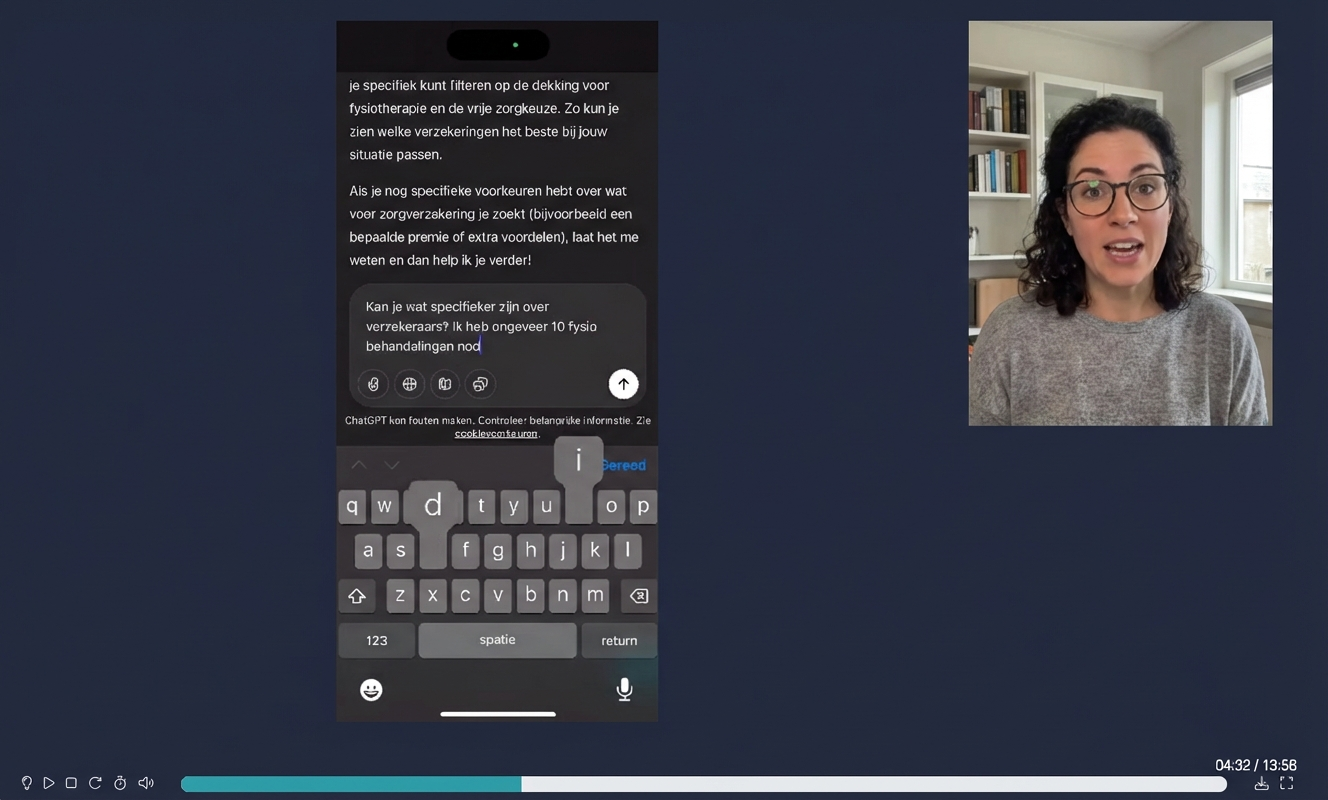
To simulate real-world behavior as closely as possible, the study was conducted during the peak of the Dutch health insurance season (between Christmas and New Year’s), when the majority of people switch providers. The qualitative research yielded several interesting insights:
Comparing the information provided by ChatGPT with that of ZorgKiezer revealed further insights.
The most striking difference was in the pricing. In one test, ChatGPT suggested a monthly premium of €138 for the given scenario. However, the premiums on ZorgKiezer started around €158. ChatGPT's result was factually impossible, as base premiums for 2026 start at €142. This highlights that ChatGPT often relies on outdated information and can make mistakes.
Furthermore, respondents preferred ZorgKiezer’s layout, where they could see the full package details and reimbursements at a glance. The information was rated as higher quality, and the platform immediately guided users into the sign-up process. ChatGPT’s output remains more informational than conversion-oriented—a trend we still see in early 2026, though we expect it to become more transaction-focused in the future.
Xander Snijders, CCO at DGN Groep (the parent company of ZorgKiezer), notes: "Comparing health insurance is ultimately about trust: people want to be certain that premiums and reimbursements are correct. That’s why transparent, up-to-date information is our foundation. At the same time, it’s fascinating to see how search behavior is shifting through tools like ChatGPT, and how we can optimize our platform to complement that journey."
This research has given us a better understanding of how people use ChatGPT in a comparison process. In short: ChatGPT’s role is supportive, not (yet) a replacement. Websites can capitalize on this trend by making themselves 'discoverable' for LLMs and by integrating AI-powered features—like conversational assistants—that offer the same personalized, question-based experience users enjoy in ChatGPT.
However, marketers and CRO specialists shouldn't stare themselves blind on LLMs. For now, the vast majority of traffic still comes through traditional channels, and your website remains the primary source of truth. The message is clear: invest in an AI-proof future, but don't stop investing in the present. Keep researching user behavior, dive into your data, and keep A/B testing to optimize your platform.
Want to learn more about how people interact with your brand through ChatGPT and how your website can adapt? Consider using user testing. Get in touch with us or User Sense, and we’ll be happy to help you out!


