


The world of e-commerce and digital strategies evolves rapidly. This blog may contain insights that have since been surpassed by new developments. Curious about the latest trends and fresh perspectives? Dive into our most current articles on Insights.
Germany is close enough to feel familiar. For a Dutch e-commerce brand, that can be both reassuring and dangerous. The border is only a few hours away. The infrastructure is strong, online shopping is well established, and many of the same platforms are available. It’s easy to assume that expanding into Germany mainly means translating the webshop, adding a larger media budget and shipping orders a little further east.
But Germany isn’t just the Netherlands five times the scale.
It’s a different market, with different consumer expectations, payment habits, competitive dynamics and legal requirements. Brands that recognize those differences early can unlock significant growth. Brands that don’t often spend months wondering why the strategy that worked so well at home has suddenly stopped delivering.
Germany has almost 84 million inhabitants, making its population nearly five times larger than that of the Netherlands. German consumers spent €88.8 billion online in 2025, while the Dutch e-commerce market was estimated at around €36.5 billion.¹
That scale creates a major opportunity. It also attracts more competition.
Germany has enough potential, but the real question is whether your brand is prepared to approach the market differently.
The Netherlands is already one of Europe’s most mature online shopping markets. Dutch consumers are comfortable ordering online, shopping across borders and buying from brands they may not have known for very long.
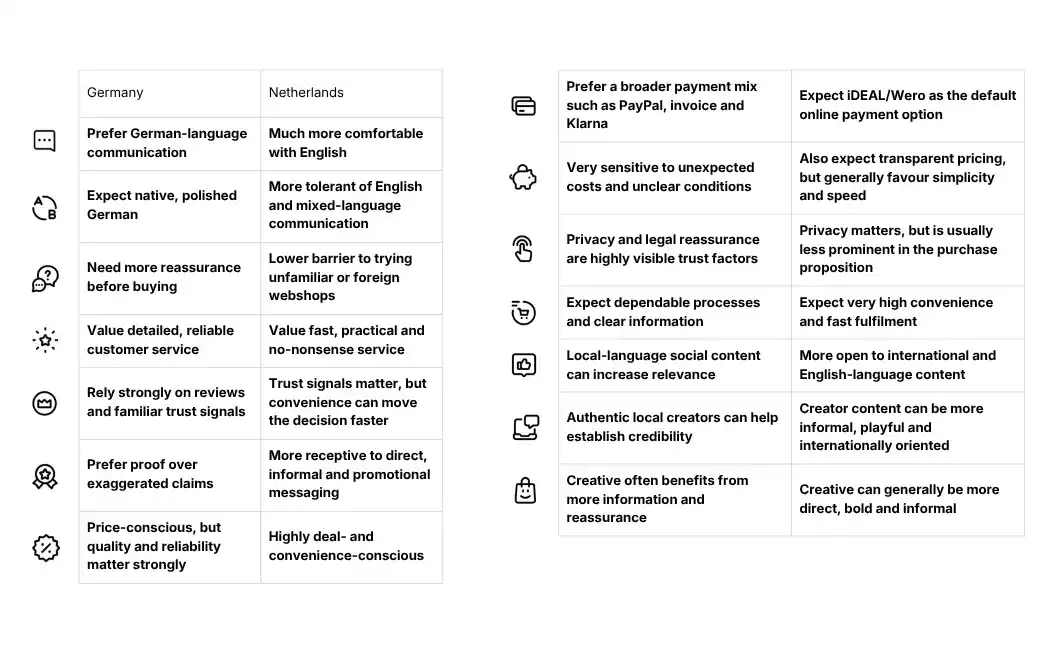
Germany is also a mature e-commerce market, but familiarity and trust often play a larger role in the decision. German shoppers may spend more time checking who is behind a webshop, reading reviews and comparing alternatives before making a purchase. According to Trusted Shops, 45% of surveyed German shoppers said they would abandon a purchase if they didn’t consider the shop trustworthy.² That changes the way an unfamiliar Dutch brand needs to present itself.
A strong product and competitive price may be enough to generate interest. They aren’t always enough to close the sale. German consumers may also look for a familiar domain, clear legal information, transparent returns, support in the local language, recognizable payment options, and independent proof that the shop can be trusted.
This doesn’t mean Dutch consumers don’t care about trust. They do. The difference is often the amount of reassurance required before someone is comfortable taking the risk.
In the Netherlands, convenience and price can move the decision forward quickly. In Germany, quality, reviews, and reliability may need to be established first. KVK specifically advises Dutch sellers to reconsider Dutch-style messaging being “the best and the cheapest” because German customers may place emphasis on quality and reviews instead.³
A literal translation can therefore preserve the words while losing the reason someone should buy.

Dutch e-commerce is built around speed and simplicity.
Consumers are used to fast checkouts, direct payment through iDEAL, and a relatively informal communication style. Promotions are often clear and direct. Convenience matters, and many people are comfortable making decisions quickly when the price and offer feel right.
German buying behaviour can involve a longer consideration process, especially for unfamiliar brands, higher-value products, or purchases where quality is difficult to judge online.
People may visit the webshop more than once. They may search for reviews outside your own website, compare the offer on a marketplace, or return through a branded Google search several days later. That means the first visit doesn’t always need to result in purchases. It does need to leave the right impression.
Your product information should answer practical questions. Your claims should be specific enough to believe. Delivery and return conditions should be easy to find. Reviews should feel genuine rather than translated or imported without context.
Tone also matters. Dutch communication often values informality, humour and efficiency. German copy can still be warm and modern, but exaggerated promises or overly casual language may reduce credibility for certain audiences. It’s important to understand how your particular audience balances emotion, information and proof.
A younger fashion audience won’t behave in the same way as someone buying furniture, electronics, or an expensive health product. But across categories, it’s risky to assume that Dutch purchase triggers will deliver the same results in Germany.
Nothing reveals the gap between the two markets more clearly than the checkout.
In the Netherlands, iDEAL is deeply embedded in online shopping. It accounts for a large share of Dutch online transactions and gives shoppers a quick, familiar way to pay directly through their bank.⁴
Germany doesn’t have one equivalent method that dominates in exactly the same way.
PayPal is widely used, while payment after delivery, Klarna, credit cards, and bank-based methods also play important roles. The preferred mix depends on the audience and product category, but the broader lesson is clear: a checkout designed around Dutch habits won’t automatically meet German expectations.⁵
A German shopper who doesn’t know your brand may feel more comfortable paying through PayPal or ordering on account than paying upfront through an unfamiliar method. Removing that option can make the purchase feel riskier, even when everything else looks professional.
The reverse is also true. Adding every possible payment provider without understanding the financial implications can increase fees, fraud risk, and operational complexity. The right mix should be based on local preference, product value, customer risk, and margin.
Germany offers a much larger potential audience, but that audience is being targeted by local players, international brands, established marketplaces, and Dutch competitors looking at the same growth opportunity. That has consequences for paid media.
It would be too simplistic to say that every German click or impression is automatically more expensive. CPCs and CPMs vary by platform, product category, season, audience and campaign quality.
What is safe to assume is that Dutch benchmarks won’t transfer neatly.
A brand may face larger competitors, more advertisers bidding on high-intent terms, and more developed category leaders with stronger brand recognition. In competitive sectors such as fashion, beauty, electronics, and home, entering the auction with translated ads and the same target CPA can lead to disappointment.
The larger market also means you may need more budget to learn properly. A small Dutch campaign can cover a meaningful share of the available audience. The same budget in Germany may be spread across far more people, regions, and search behaviour. When the data is fragmented, it becomes harder to understand whether the proposition is weak or the test simply wasn’t large enough.
This is why the German media plan needs its own commercial logic.
Start by assessing local search demand, competitors, margins, and realistic acquisition costs. Decide which products are strong enough to absorb a higher initial CPA and which categories provide a real point of difference.
The goal shouldn’t be to make Germany perform exactly like the Netherlands from day one. The first objective is to identify a model that can become profitable as local recognition and data improve.
Dutch e-commerce is strongly shaped by direct-to-consumer webshops, Google, social platforms and marketplaces such as bol.
German shopping journeys often give a more prominent role to large marketplaces and established retail platforms. Amazon, Zalando and eBay are major players, and German online marketplaces generated €44 billion in turnover in 2024 according to KVK.⁶ These platforms influence what German consumers expect from price, availability, delivery and service. They may also appear during the research process, even when the final purchase happens on your own website.
Search has a similarly important role. German consumers researching an unfamiliar brand may use Google to search for reviews, alternatives, delivery experiences, and the legitimacy of the company. A search strategy, therefore, needs to cover more than direct product keywords. Branded search, category terms, comparison searches, and queries related to quality or product use can all contribute to the journey.
Social media can introduce the brand and create desire, but it may have to work harder to establish confidence. A Meta or TikTok ad can generate the first visit, while Google, reviews, and retargeting support the eventual purchase. This is where judging every channel purely by last-click revenue becomes misleading.
A social campaign may appear inefficient because consumers convert later through Search. A marketplace may help establish price expectations without receiving the transaction. A review platform may influence the decision without appearing in the attribution path at all.
The channel mix should reflect how German consumers actually move from discovery to purchase, not how your Dutch reporting structure divides the credit.
You won’t only be competing on product and price but with businesses that already feel familiar.
A German competitor may have a local domain, thousands of German-language reviews, recognizable service partners, and years of brand awareness. Even if your product is better, the established shop may feel like the safer choice. This is why local trust signals deserve a deliberate place in the strategy.
A .de domain can make the experience feel more familiar. German contact information and customer service reduce uncertainty. Independent reviews and trust marks can reassure people that someone else has already assessed the shop.
Trusted Shops, TÜV and EHI are examples of trust signals German customers may recognize. These badges don’t magically create conversion, but they support a wider experience that already feels credible.⁷
The same applies to local reviews. A large number of Dutch or English reviews is better than no proof at all, but German-language reviews that mention delivery, service and the actual product experience are likely to feel more relevant.
Trust should also be visible in:
Germany has detailed consumer protection and e-commerce requirements. A webshop that complies with Dutch rules isn’t automatically ready to sell in Germany.
The Impressum is one of the most visible differences. German online shops need to clearly identify the company behind the website, including relevant legal and contact information.
German-language terms and conditions, privacy information, and the Widerrufsbelehrung (cancellation policy) also need to be correctly prepared. Consumers generally have a 14-day right of withdrawal for qualifying online purchases, and the process must be communicated before the sale, clearly visible on the website, and easy to access.⁸
Product-specific obligations may apply as well. The German Packaging Act can require businesses placing packaged products on the German market to register and participate in the relevant recycling system. Companies selling batteries, electronics or certain disposable plastics may face additional registration and take-back obligations.⁹
VAT also needs attention. Depending on total cross-border EU sales and the company’s setup, German VAT may need to be collected and reported through the EU One-Stop Shop or through a German registration.¹⁰ These aren’t details to solve after the first orders arrive. German legal compliance should be reviewed prior to the launch by specialists who understand the brand, products and sales model. An incomplete legal setup can create financial risk, damage trust and delay growth at the exact moment the company is trying to build momentum.
From a logistics perspective, Germany is conveniently close. Orders can be shipped from the Netherlands without crossing an external EU customs border, and Dutch fulfillment infrastructure is among the strongest in Europe.
But the customer doesn’t judge your logistics based on geography. They judge whether the parcel arrives when promised, whether tracking works, how convenient the delivery options are, and what happens when the product needs to be returned.
Delivery speed, damaged parcels, limited delivery locations, and poor tracking are among the recurring frustrations consumers report when shopping across borders.¹¹
Shipping from a Dutch warehouse may work perfectly well during the first stage of expansion. The important part is setting realistic expectations and choosing carriers with strong German coverage. As volumes grow, local fulfillment or a partner with German infrastructure may improve delivery speed, returns handling and customer service. Whether that investment makes sense depends on order volume, product type, average order value and the role of delivery speed in conversion.
Returns deserve the same attention. A brand may successfully generate German sales and still lose money if return rates, shipping costs and processing times haven’t been included in the business case. This matters especially in categories such as fashion, where returns can strongly affect net revenue.
The expansion model should therefore be built on profit after fulfilment and returns, not only on gross webshop revenue.

Germany is attractive because it offers more consumers, more online spending and more room to scale. It’s challenging for exactly the same reason.
A larger market brings more competitors, more expensive mistakes and more variation in customer behaviour. The brands that succeed aren’t necessarily those with the largest launch budget. They’re the ones that understand where the Dutch playbook stops working.
They recognise that German consumers may need more proof, adapt the checkout instead of forcing Dutch payment habits onto another market, build a channel strategy around local journeys rather than copying the existing account structure, and prepare legal and operational requirements before those requirements become problems.
And they accept that acquisition costs, conversion rates and growth speed may look different while the brand is still earning recognition.
Entering the German market doesn’t need to begin with a national campaign and a fully local organisation. A focused test can be more valuable.
Start with a product category that has enough margin and a clear reason to win. Research German demand and competition. Build a localized proposition rather than translating the Dutch one. Offer the payment methods and trust signals people expect. Make sure the legal foundation and logistics can handle the first orders. Then measure more than media performance.
Look at branded search, checkout behaviour, payment use, support questions, return reasons, repeat purchases, and the role different channels play before the conversion. Those insights tell you whether the brand is genuinely gaining traction or simply buying temporary revenue.
Germany could become your biggest e-commerce opportunity yet. Not because it’s a larger version of the Netherlands, but because it gives brands that understand the differences far more room to grow.
The border may be close. The strategy shouldn’t be the same.
Curious to learn more? Let’s talk!
Citations:
¹ KVK, E-commerce in Germany; E-commerce Germany News, European E-commerce Overview: Benelux
² Trusted Shops, Entering the German E-commerce Market
³ KVK, E-commerce in Germany
⁴ E-commerce Germany News, European E-commerce Overview: Benelux
⁵ KVK, E-commerce in Germany
⁶ KVK, E-commerce in Germany
⁷ KVK, E-commerce in Germany
⁸ KVK, E-commerce in Germany
⁹ KVK, E-commerce in Germany
¹⁰ KVK, E-commerce in Germany
¹¹ FedEx, Understanding the European E-commerce Market


