


The world of e-commerce and digital strategies evolves rapidly. This blog may contain insights that have since been surpassed by new developments. Curious about the latest trends and fresh perspectives? Dive into our most current articles on Insights.
Try this: google your own brand name together with "discount" or "discount code". They pop up almost immediately: voucher code sites, cashback platforms and comparison sites that have built a page about your brand. Pages that claim to list every current discount, but in practice are mostly stuffed with codes that expired ages ago, codes that never worked, and a bold promise of "up to 50% off" that nobody can trace back to anything.
For many webshop owners, these pages are a thorn in the side, and rightly so. Every customer who had already decided to buy from you and quickly hunts for a code right before checkout ends up there. If the code doesn't work, the customer gets frustrated. If it does work, and you run an affiliate programme, you suddenly pay commission to the voucher site that claims the placement. On a transaction you would have closed without their involvement anyway. There's a reason we've been proactively barring these publishers from the programmes we manage for years.
Fortunately, there's a remarkably simple fix: your own discount code and deals page. Not a campaign, not some fancy "growth hack". Just a page, set up properly and kept up to date. One of the few interventions that improves the customer experience and protects your margin at the same time.
Someone searching for "brand name + discount code" sits at the very bottom of the funnel. It hardly gets deeper. That customer already knows which product they want and which shop they're buying it from. They're just trying to shave a few pounds off.
That's exactly where discount code affiliates aim their entire content strategy. Not at your category, not at your product, but at your brand name combined with "discount", "deal", "offer" or "voucher code". They write a page about a brand they have nothing to do with, wait for it to rank, and then claim commission on orders that were going to happen regardless.
It costs you money twice. Directly, because you pay commission on a conversion that would have happened anyway. And indirectly, because your customer leaves your checkout to go searching. Some of those people never come back. The hunt for a discount code is, in itself, already a conversion leak.
Say you take our advice and remove every voucher site from your affiliate programme. Problem solved? No. That page stays online and keeps ranking on your brand name. The direct margin leak is plugged, but the customer frustration isn't. And it can get worse: what if that page stops linking to you and links to a competitor that does have a working code? Then you don't just lose the discount, you lose the whole order.
One page of your own solves five things at once:
First, remember that you hold the strongest cards on your own brand name. It's your brand, your domain, your authority. If you still lose that position, it's rarely because the competition is so strong. It's simply because your own page doesn't exist. Not a fight you lose, but a chance you leave on the table.
The setup itself is hardly rocket science. Build the page around the variants people actually type:
Give the page its own permanent URL and link to it from your header or footer, and perhaps even more importantly, from your checkout, right by the field where customers enter a code. That keeps the code hunter inside your own environment instead of sending them out of your shop.
Content-wise, the page should include at least:
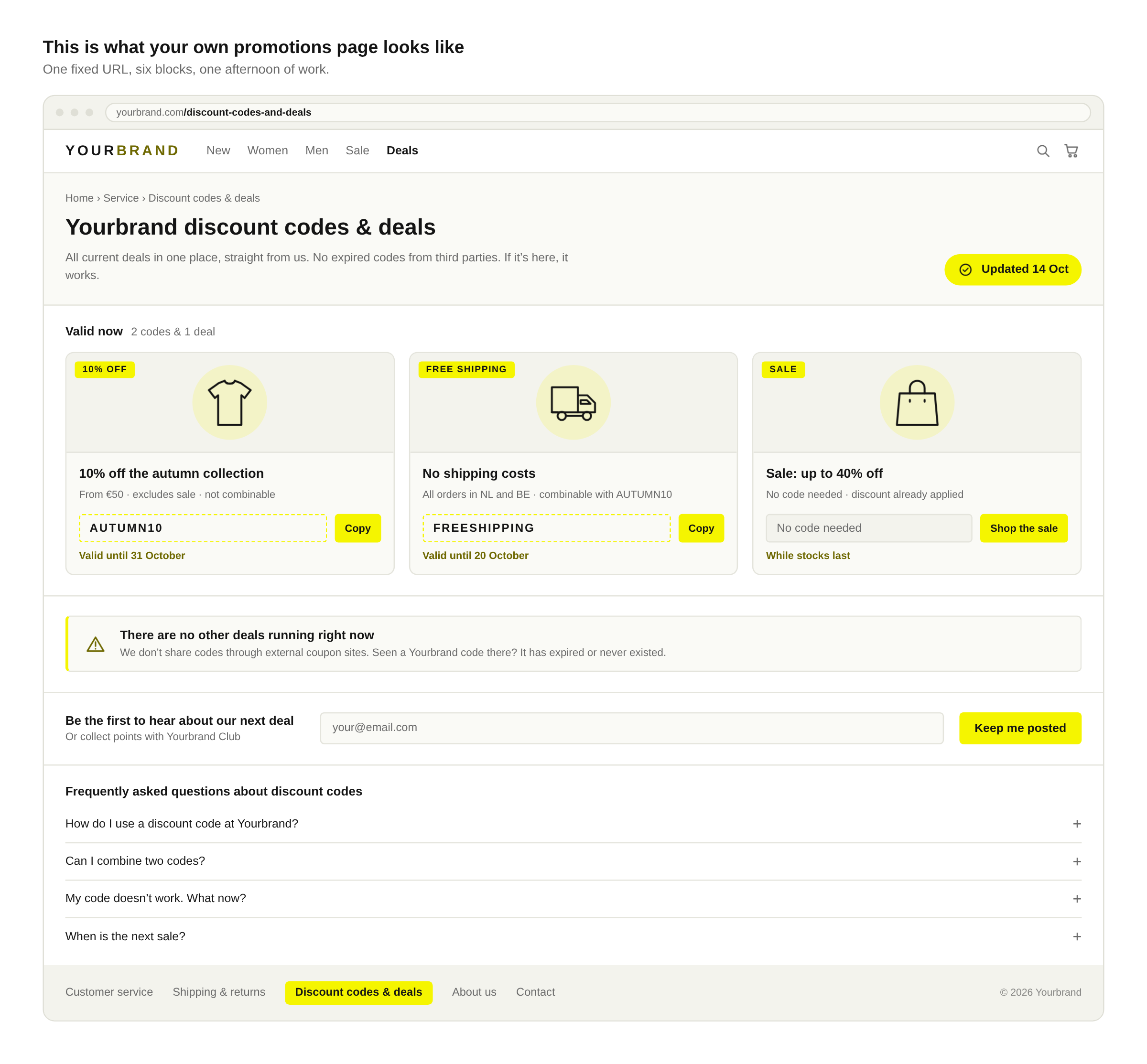
This is where it goes wrong in practice. The page gets built with great enthusiasm, and a quarter later it's still showing a summer sale that ended in August. Congratulations: you've become exactly what you set out to fight.
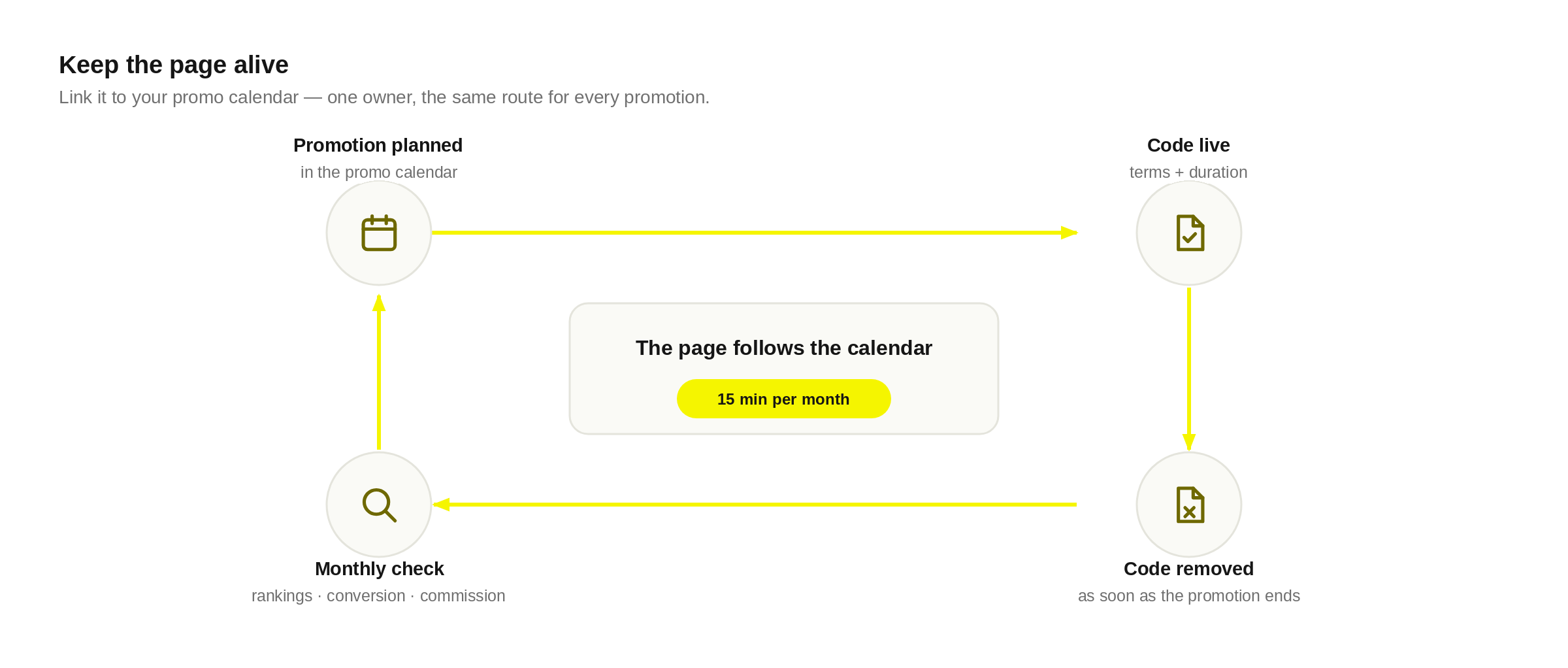
So assign ownership to one person, not to "marketing", and tie the page to your promotion calendar: when a deal goes live, the page goes live with it; when it ends, the page follows.
Then keep an eye on performance. Watch your rankings on the relevant searches, the conversion rate on the page itself, and, if you run an affiliate programme, the share of voucher and cashback partners in your affiliate revenue. That last number is the most interesting: if it drops while your total revenue stays flat, you've effectively won back margin.
It's the objection we hear most, and it's wrong. The demand for discounts already exists. Your own deals page doesn't change that. In other words: you don't create the demand, you just decide where the answer comes from.
Besides, you're in charge on your own page. No stackable codes, a minimum order value, or a newsletter sign-up instead of a discount: all choices a voucher site would never make on your behalf.
Deliberately never work with codes or promotions? Then the page is just as useful. One short, clear page stating that you don't issue codes, and why, captures the search traffic of parties that would otherwise invent codes that don't exist.
Also worth realising: if you're willing to give away margin anyway, you're often better off handing it straight to the customer than paying the same margin as commission to a voucher publisher. Why reward a discount code site for referring a customer, when you could give that customer the benefit directly?
Let's not make it bigger than it is. Your own deals page won't save your quarterly figures or trigger a sudden uplift. It's basic housekeeping: an afternoon to set up, then fifteen minutes a month to maintain. And that's exactly why it gets left undone. Nobody owns it.
Meanwhile, information about your discount codes is out there online. The question isn't whether it exists. The question is who's writing it.
Want to know where your affiliate programme is losing margin and incrementality?
We're happy to look at your branded search results, your publishers, commissions and conversion paths. Together we'll map out where the real added value sits and where there's room to run the channel smarter, more transparently and more profitably.
Within two hours, we'll know exactly where the potential of your programme lies.
Interested? Get in touch.


