


The world of e-commerce and digital strategies evolves rapidly. This blog may contain insights that have since been surpassed by new developments. Curious about the latest trends and fresh perspectives? Dive into our most current articles on Insights.
Expanding into Germany, Austria, and Switzerland can be a major growth opportunity for international brands. Together, the DACH countries offer high purchasing power, mature e-commerce markets, and a large base of quality-conscious consumers and businesses. The region’s combined GDP exceeds €6 trillion¹, which helps explain why it features so prominently in international expansion plans.
However, for a successful expansion, a German-language website and a few localized ads are rarely enough. Customers expect proper localization from product information and payment methods to customer service, delivery, returns, and legal compliance.
Brands that gain traction are usually the ones that prepare the market before they try to scale.
Here’s what should be in place before entering the DACH region.
One of the most common mistakes is treating Germany, Austria, and Switzerland as one homogeneous market simply because German is widely spoken across all three countries.
There are similarities, but there are also important differences in:
Germany is usually the obvious starting point because of its scale, but it’s also highly competitive. Austria can be a logical next step once a German setup is working, and Switzerland offers strong purchasing power but requires a separate approach to currency, customs, taxes, and often language.
Before the launch, build a business case for each country:
Where is the strongest demand for your product(s) or service(s)?
A market can look attractive in a spreadsheet and still be the wrong place to launch first. Validate the opportunity with local customers, partners, and industry experts before committing significant budget.
Translation makes your content understandable, but localization is what makes your brand feel credible.
Customers quickly notice when a website has simply been translated from another market. Awkward wording, unfamiliar payment options, missing product details, and inconsistent customer communication all create friction.
Localization should cover the complete experience:
Website and product pages: Use natural local language and provide the level of detail customers expect, including specifications, dimensions, materials, warranty information, compatibility, and delivery details.
Checkout:Show local currency where relevant, familiar payment methods, transparent shipping costs, and clear delivery expectations.
Customer communication: Order confirmations, delivery updates, return instructions, service emails, and FAQs should all be written naturally for the local market.
Marketing: Adapt search terms, advertising copy, creatives, offers, and messaging to local behavior rather than just translating existing campaigns.
Customer service: Customers should be able to get help in their language without being pushed back to an English-speaking team.
A useful test is simple: Could a customer discover the brand, compare products, buy and receive the order, return it, and contact support without ever needing to switch to English or using a translator? If not, the experience isn’t fully localized yet.
Trust plays a major role in DACH, especially when customers are buying from a brand they’ve never heard of before.
A strong advertising campaign may get someone onto your website, but paid media cannot compensate for a website that feels unfamiliar or incomplete. Before scaling acquisition, make sure the brand gives customers enough reasons to trust it.
Important trust signals can include:
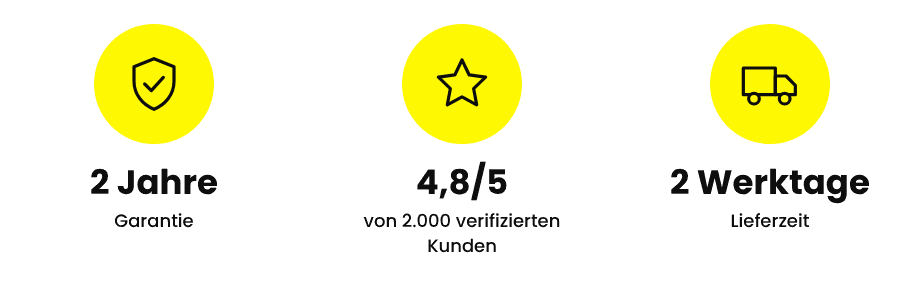
For B2B companies, the same principle applies through case studies, references, methodology, technical documentation, and clearly identifiable experts. DACH buyers often respond better to proof than promises. The claim “best quality” says very little, whereas “2-year warranty, 4.8/5 from 2,000 verified customers, and delivery within two business days” gives the customer something concrete to evaluate.
Compliance should be part of the market-entry preparation, not something you fix after campaigns go live. Depending on your product or service, this can include:
Germany and Austria are both EU countries, but that doesn’t mean every commercial requirement is identical. Switzerland needs particular attention because it sits outside the EU, so customs, tax, invoicing, and cross-border fulfillment need to be modeled separately.
For B2B companies, privacy, contracting, security, insurance, and data-processing documentation may also be examined early in the buying process.
Getting this right avoids unnecessary risks and strengthens trust through professional legal and privacy documentation.
A customer can be convinced by the product and still abandon the purchase because the checkout doesn’t feel familiar or trustworthy. Payment preferences vary across the three countries, and brands should avoid assuming that the payment options from their home market will automatically translate. For instance, in Germany, PayPal and invoice payments together account for more than half of online revenue,² so payment options can make or break the final purchase.
Depending on the market, relevant options may include:
Before launch, test the complete purchasing journey on both mobile and desktop: Product page → cart → checkout → payment → confirmation → shipping communication → return. For a new brand, small inconsistencies can create disproportionately large trust issues.

The customer experience doesn’t end when someone clicks “Complete purchase.” In fact, that’s when the operational side of your market entry starts being tested.
Before launch, define:
Customers don’t necessarily expect every brand to deliver overnight, but they do expect the promise you make to be accurate. Often brands claim delivery within 2-3 days in their home market, and use this USP in the DACH market without making sure it’s actually true.
Returns are particularly important for ecommerce brands because they can significantly change the economics of expansion. A market may look profitable when measured on revenue or ROAS but become much less attractive after accounting for media costs, shipping, return costs, refunds, and customer service
That’s why market-entry profitability should be evaluated after returns rather than purely on top-line sales. The goal should then be to reduce avoidable returns through better product information, photography, sizing, comparison tools, and expectation management.
DACH customers have access to mature marketplaces, comparison sites, review platforms, and established local retailers. That means your offer is rarely evaluated in isolation.
You don’t necessarily have to be the cheapest, but if you are more expensive, customers should immediately understand why.
Do this competitive benchmark before you launch, rather than waiting until campaigns underperform.
Your existing channel strategy may not be the best for DACH. Depending on the business, market entry can involve:
For ecommerce brands, the right combination often balances short-term acquisition with channels that build local credibility. For B2B companies, a local sales partner, distributor, industry network, or trade fair may be more important than immediately scaling digital lead generation.
Ask:
This is especially relevant for B2B expansion. DACH buyers often value structured communication, preparation, reliability, and clear follow-up.
That means:
The goal is to make working with your company feel predictable, professional, and low-risk. That reassurance can be more persuasive than an aggressive sales pitch.
Customer service is one of the fastest ways for a supposedly localized brand to suddenly feel foreign. Customers should be able to easily find:
Where possible, provide native or highly fluent German-language support.
This matters commercially too. Clear support information reduces uncertainty before purchase, while good post-purchase service helps protect reviews, retention, and repeat business. Customer service should therefore be treated as part of conversion and retention, not just an operational cost.
Switzerland deserves special attention rather than being added to the German strategy as an afterthought.
It’s outside the EU, uses Swiss francs, and has its own tax, customs, payment, and consumer expectations. Depending on the regions you target, German may also not be sufficient.
Before launching in Switzerland, think about this:
For many brands, Switzerland makes sense after validating the model in Germany. For premium or higher-margin businesses, the economics may justify entering earlier. Either way, it should be a deliberate decision rather than simply checking a “DACH” box.

Revenue is only part of the picture. Setting clear metrics up front shows you whether a market is worth scaling before you've committed serious budget.
The important point is to know what a healthy market looks like before you start scaling it. Trying to launch across Germany, Austria, and Switzerland at full scale from day one creates unnecessary risk.
The strongest market-entry strategies are rarely the fastest ones, but the ones that create enough evidence to know what should be scaled and what still needs fixing.
DACH offers significant growth potential, but it’s not a market where a half-localized setup tends to perform well. Customers don’t necessarily expect your business to be German, Austrian, or Swiss. They do expect it to understand how the market works. That means having the fundamentals in place before aggressively investing in acquisition
Once those foundations are solid, marketing can do what it’s supposed to do: create demand and accelerate growth.
Want to learn more about expanding into the DACH market? We’d be happy to help. Let’s talk!
Sources:
¹Destatis, Statistik Austria, Swiss Federal Statistical Office (BFS), 2025 nominal GDP.
² EHI Retail Institute, Online-Payment 2026.


